Do Conservatives Love Their Children?
No, Lyman, Kids Don't Walk to Bars

[ed. note: In honor of National Bike to Work Day May 15, I’m donating $120 to my local bicycle advocacy group, which works on safe streets to school for children, among other topics]
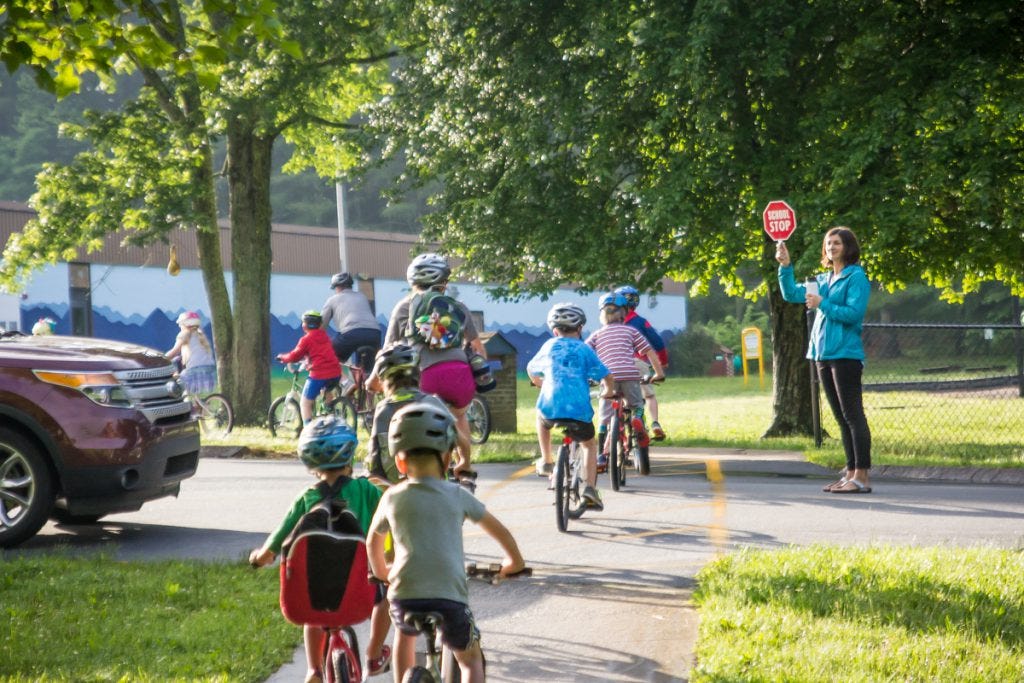
From time to time, the American right will get into a heated public debate that’s worth watching closely. Like far-left advocacy, the far right is often intellectually incoherent and riddled with charlatans and snake-oil salesmen. And even still, when the light of the moon hits just so, reality will manage to break through and offer a small, short window for insight.
Witness this petty but clarifying skirmish between Tim Carney and Lyman Stone about whether the well-being of American kids is tied to their ability, or lack thereof, to walk to a friend’s house:


Carney makes the conservative case for walkability — for sidewalks, slower streets, and neighborhoods where an eight-year-old can leave the front yard without being run over. What’s unusual about this piece (aside from the fact that the radically right-wing Washington Examiner published something that promotes safe streets) is that Carney basically accepts the overwhelming research available on the topic.
The pattern of childhood morbidity and mortality follows the geography of sprawl, not the geography of screens.
Then there’s Stone’s approach. Like all conservative carnival barkers, Stone falls back on “cultural decay” (as if that’s something that can be measured) as the cause of childhood immobility. The problem with his conclusion, in addition to it being wrong, is how he arrived at it:
By reverse engineering his preferred land use form – suburban sprawl with Big Government driving mandates – and shoehorning his bogus research in to support that pre-determined agenda.
But the peer-reviewed evidence sides, decisively, with Carney.
The IFS brief by Toscano, Stone, and Bailey lands on a striking statistic: By age 17, roughly 60% of American kids still aren’t allowed to leave their neighborhood unsupervised. The paper then skips all the evidence, and instead reaches for bespoke, small-batch explanations that align with the authors’ cultural priors: too much screen time, permissive technology norms, parents who won’t grant independence.
The authors treat children’s collapsed independence as principally a problem of parenting culture and digital media. The built environment goes essentially unmentioned. When pressed by Carney on social media, Stone doubled down, citing the EPA’s National Walkability Index to argue that built form doesn’t predict children’s freedom to roam.
It is Difficult to Get a Man to Understand Something
This is a remarkable omission, because the empirical literature on children’s independent mobility has spent two decades pointing to exactly the cause Stone talks around — and Carney, to his credit, names directly.
Carver, Timperio, and Crawford’s 2008 review in Health & Place established that perceived and objective neighborhood safety is the proximate determinant of parents granting their children independent mobility. But while in Stone’s world, “neighborhood safety” is a dog-whistle for “there might be unwhite, un-Christian people out there,” the authors define “safety” objectively: traffic volume, traffic speed, and road crossings.
After all, in the United States of 2026, with non-car crime at record lows, the word “safety” mostly refers to the threat of being hit and injured or killed by a driver.
Villanueva and colleagues, in Children’s Geographies in 2014, showed that neighborhood walkability significantly predicts children’s independent mobility even after controlling for parental attitudes and confidence — which is to say, the built environment matters in addition to, not just because of, helicopter parenting.
Rothman and colleagues’ 2014 systematic review in Injury Prevention identified traffic calming, slower speed limits, and pedestrian infrastructure as the only built-environment factors consistently associated with both more child walking and fewer pedestrian injuries. Schoeppe et al.’s 2013 systematic review in the Journal of Science and Medicine in Sport established the health stakes: children with greater independent mobility accumulate significantly more physical activity, less sedentary time, and healthier weight outcomes.
And the kicker: Car crashes play an outsized role in childhood morbidity and mortality, and are worse in suburbs and rural areas. Cunningham, Walton, and Carter’s 2018 New England Journal of Medicine paper documented that motor vehicle crashes were a leading single cause of death for Americans aged 1–19, with rural death rates 2.7 times urban rates — a pattern that follows the geography of sprawl, not the geography of screens.
DiMaggio and Li’s 2013 Pediatrics paper found that Safe Routes to School infrastructure like sidewalks, traffic calming, and crossing improvements in New York City reduced school-aged pedestrian injury by 33%, far more than in age groups not exposed to the interventions.
What, Your Kid Doesn’t Walk to the Bar?
It’s almost too obvious to have to say, but because Stone continues to deny the evidence it has to be said: When you build streets that are safe for children to walk on, fewer children get hit by drivers, and more children walk. When you don’t, the opposite.
So it doesn’t actually matter whether, in Stone’s eyes, American families are in a state of “cultural decay.” Any good parent is going to act to protect their child from violence and death. And in the United States, that means protecting them from the horrific violence of car culture, and the deadly streets that most American families are literally surrounded by, on all sides – due entirely to Big Government’s ongoing intervention in housing and transportation markets.
Stone’s defense of his anti-built-environment position rests on the EPA’s walkability index, which, as Carney correctly notes, is a terrible measure. The EPA’s methodology weights intersection density, transit proximity, and employment mix, which are all adult commuter concerns. None of these are relevant to whether a child can actually cross the street without being killed.
Parks and playgrounds are not counted. Traffic speed is not counted. Traffic volume is not counted. Sidewalks are not counted. Stone is using a measure designed to evaluate whether grown-ups can walk to a cocktail bar to argue that the built environment doesn’t affect whether children can walk to a friend’s house. The peer-reviewed literature uses better measures, and finds the opposite.
All this would be another silly online battle, but Stone is not a neutral observer of American land use. He is one of its most vocal anti-YIMBY, pro-suburban defenders. In More Crowding, Fewer Babies, his June 2024 IFS report, he argues that YIMBY upzoning is fertility-suppressing and recommends instead that reform efforts focus on building “out” in his preferred form of greenfield single-family subdivisions on exurban land, rather than “up.” In his Young Americans Want Single-Family Homes brief, he writes, “the main focus of any family-friendly housing policy should be on expanding the supply of single-family homes.”
Stone has built an entire pro-natalist policy framework on the premise that detached single-family suburban housing is the natural and proper environment for raising children. But when the data shows that the suburbs he champions are exactly where American children have been stripped of their independence and health, he … blames the phones.
Credit Where and When It’s Due
To his credit – three words that are painful for me to write, given Carney’s other policy positions – Carney is making a legitimately pro-family case here. His prescription is the one the peer-reviewed literature supports: slower cars, fewer lanes, sidewalks, playgrounds, walkable schools, traffic calming. He is even willing to name the trade-off honestly; while safe streets are “a sacrifice for drivers,” conservatives should make it anyway:
The alternative is the eight-year-old who can’t walk to her friend’s house, the 12-year-old who can’t bike to practice, the 14-year-old who can’t wander the neighborhood with their friends until they’re called home for dinner – and the parents who spend all their free time shuttling kids around a car-dominated landscape that has functionally banned childhood.
Stone’s prescription is more of the same land-use pattern that produced the problem. Oh, that, and scolding busy, over-tasked parents about how much screen time they let their kids have.
I’m sure that will go over great.
Citations
Carney, T. P. (2026, May 10). “The Pro-Family Case for Walkability.” Washington Examiner (republished by American Enterprise Institute). https://www.aei.org/op-eds/the-pro-family-case-for-walkability/
Toscano, M., Stone, L., & Bailey, G. (2026, May 5). “New IFS Brief: More Screen Time, Less Play Time For America’s Kids.” Institute for Family Studies. https://ifstudies.org/blog/new-ifs-brief-more-screen-time-less-play-for-americas-kids
Stone, L., Toscano, M., & Burchfiel, K. (2024, June). “More Crowding, Fewer Babies: The Effects of Housing Density on Fertility.” Institute for Family Studies. https://ifstudies.org/blog/more-crowding-fewer-babies-the-effects-of-housing-density-on-fertility
Stone, L. (2025). “Young Americans Want Single-Family Homes.” Institute for Family Studies. https://ifstudies.org/blog/young-americans-want-single-family-homes
Carver, A., Timperio, A., & Crawford, D. (2008). “Playing it safe: The influence of neighbourhood safety on children’s physical activity — a review.” Health & Place, 14(2), 217–227. https://www.sciencedirect.com/science/article/abs/pii/S1353829207000615 DOI: 10.1016/j.healthplace.2007.06.004
Villanueva, K., Giles-Corti, B., Bulsara, M., Trapp, G., Timperio, A., McCormack, G., & Van Niel, K. (2014). “Does the walkability of neighbourhoods affect children’s independent mobility, independent of parental, socio-cultural and individual factors?” Children’s Geographies, 12(4), 393–411. https://www.tandfonline.com/doi/abs/10.1080/14733285.2013.812311 Free copy: https://researchonline.nd.edu.au/health_article/114 DOI: 10.1080/14733285.2013.812311
Rothman, L., Buliung, R., Macarthur, C., To, T., & Howard, A. (2014). “Walking and child pedestrian injury: A systematic review of built environment correlates of safe walking.” Injury Prevention, 20(1), 41–49. https://injuryprevention.bmj.com/content/20/1/41 DOI: 10.1136/injuryprev-2012-040701
Schoeppe, S., Duncan, M. J., Badland, H., Oliver, M., & Curtis, C. (2013). “Associations of children’s independent mobility and active travel with physical activity, sedentary behaviour and weight status: A systematic review.” Journal of Science and Medicine in Sport, 16(4), 312–319. https://www.sciencedirect.com/science/article/pii/S1440244012002125 DOI: 10.1016/j.jsams.2012.11.001
Cunningham, R. M., Walton, M. A., & Carter, P. M. (2018). “The major causes of death in children and adolescents in the United States.” New England Journal of Medicine, 379(25), 2468–2475. https://www.nejm.org/doi/full/10.1056/NEJMsr1804754 PMC mirror: https://pmc.ncbi.nlm.nih.gov/articles/PMC6637963/ DOI: 10.1056/NEJMsr1804754
DiMaggio, C., & Li, G. (2013). “Effectiveness of a Safe Routes to School program in preventing school-aged pedestrian injury.” Pediatrics, 131(2), 290–296. https://publications.aap.org/pediatrics/article-abstract/131/2/290 PMC mirror: https://pmc.ncbi.nlm.nih.gov/articles/PMC3557410/ DOI: 10.1542/peds.2012-2182
U.S. Environmental Protection Agency. “National Walkability Index Methodology and User Guide.” https://www.epa.gov/smartgrowth/national-walkability-index-user-guide-and-methodology
I was just listening to an interview with Brent Toderian talking about why downtown Vancouver has a lot of families and downtown Seattle doesn’t. One big reason: Vancouver mandated two and three bedroom apartments be built. You can’t point to most American cities and say that the dearth of families indicates families hate cities. But you can say that families don’t like living in places built almost exclusively for young single people. I mean, duh.
It reminds me of the “minivans and more lanes are pro-family” argument I’ve seen, maybe in that same publication. In other words “people prefer driving in places built for car traffic.” Again, duh.
I do think devices and entertainment pull kids home while streets push them inside. There’s an interplay of both elements that mutually reinforce the other.
It beggars belief that anyone who has walked in different built environments would claim they would have no effect on how may people walk.
But I am not surprised that Lyman would make a ridiculously absurd argument; I blocked him some time ago because it was clear he would never concede anything that was counter to argument he was making. I don’t think anyone who claims every data point is clearly in their favor should be trusted.